
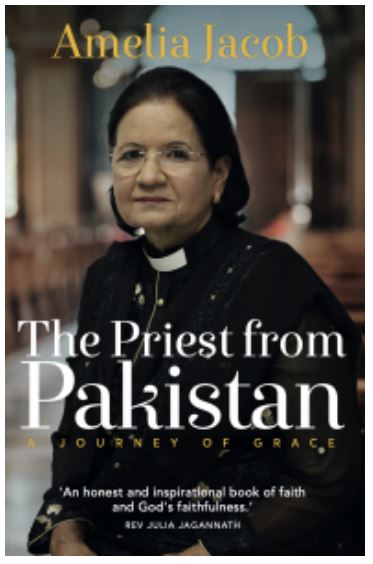
The Priest from Pakistan
Every migration story is different: Amelia Jacob’s story shows how culture can both change and not change
Amelia was brought up in a traditional family in 50s and 60s Pakistan – very different from Pakistan today. Three generations lived together in a joint family with siblings, cousins, aunts and uncles. Life was filled with cooking, cleaning, gardening, and caring for their buffalo.
Faith was simple: children were ‘trained to join in with our family’s religious practices and rituals’. They knew they were ‘part of a Christian family living in a Muslim-majority country’. There was no difficulty – the communities lived together without friction at that time. Her beloved grandfather, Dada Chunilal, was her great role model. He had come from a high caste Hindu family, turned to Christ as a young man, and served as a pastor for nearly 40 years.
When Amelia was 21 and still a student, her father received a proposal of marriage for her. The young man, Stanley, lived in the UK. Nine months later he arrived back in Pakistan and they were married.
Arriving in 70s Britain, she and Stanley made their new life together, working hard, developing his business, buying a house in Alperton, near Wembley, and having their first child. During this time their commitment to reading the Bible and attending church faded away, until they heard about a Pakistani fellowship at St Mary’s Church, Islington. They attended regularly, built up good friendships with other Pakistani Christians and enjoyed worshipping in Punjabi and Urdu. Families came from all across London and this experience of an Asian church was immensely valuable for that first generation of immigrants. (Later she reflected on its limitations for the next generation: important to link with the local church).
Spiritually Amelia was stuck and their marriage was in difficulty: too busy and tired with work and caring for small children. She went through a profound experience, realizing her need for repentance and the reality of forgiveness through the death of Jesus for her sins. It was a ‘personal encounter with the living Christ and his forgiveness’.
This led to a new commitment, and eventually to study and being ordained. She joined the staff of St James Alperton and served there for 28 years until retirement, during which she was also in the first group of women to be ordained priest at St Paul’s Cathedral.
St James had a mixture of white and black members but few Asians, although it was in a strongly Asian area. The vicar, John Root, was keen to develop a truly multicultural church and welcomed Amelia. In 2001 they started the Hindi/Urdu service, with support from Ajay More, an Indian church member. Later other language speakers joined and they renamed it ‘Christ for All Nations Fellowship’.
Interestingly, their daughter’s marriage was not arranged, but their son’s was. Amelia and Stanley then welcomed their son and new daughter-in-law to live with them as a joint family, soon of three generations. The circle was completed: during years of successfully ‘fitting into’ UK society they had also maintained the traditions of Pakistani culture.
This is not a book of strategies for multicultural ministry. But as the story of one person working things out and experiencing God in the ordinary details of life, it is full of wholesome and practical insights. These are spelled out in two summaries (p148-9 and 171-2). There is also particular advice for women seeking to minister in cross-cultural situations.

The Priest from Pakistan – a Journey of Grace
Amelia Jacob (Instant Apostle, 2023)
Available from: instantapostle.com/books/the-priest-from-pakistan


